Paying Off High-Interest Debt in 2026: Avalanche vs. Snowball, Balance Transfers, and the Minimum Payment Trap
Pay off card debt faster: 2026 rates, avalanche vs. snowball with worked numbers, balance transfer and loan math, credit score effects, and settlement risks.

Credit card interest is expensive in 2026. The Federal Reserve's G.19 release put the average rate on card accounts that were charged interest at 22.15% in the second quarter, up from 21.52% in the first, and the Fed raised its policy rate again in September. Americans carried $1.26 trillion in card balances at mid-year, according to the New York Fed, close to the record set at the end of 2025.
Paying off a 22% card is a guaranteed, tax-free 22% return, which no investment reliably matches. This guide shows how to order payments, when a balance transfer or loan helps, what the minimum payment really costs, and what to know about credit scores and settlement. If you are considering one loan to replace several debts, our debt consolidation guide goes deeper on that option.
Before you start
Two steps come before extra debt payments:
- Keep a small cash buffer, even $1,000 or a few weeks of essentials, so a car repair does not go back on the card.
- Take any employer retirement match. A 50% match is an immediate 50% return, which beats paying down a 22% card. Beyond the match, extra money usually goes further on the debt.
Then list every debt with its balance, interest rate, and minimum payment. Set up automatic minimum payments on all of them. Issuers generally report a payment to the credit bureaus as late once it is 30 days past due, and payment history is the largest part of a FICO score.
The minimum payment trap
Many issuers set the minimum at about 1% of the balance plus that month's interest. An illustration: $6,000 at 22.15%, paying only a minimum of 1% plus interest (at least $35), takes about 18 years to clear and costs about $9,576 in interest. Paying a fixed $250 a month clears it in 32 months with about $1,999 of interest. Your statement is required to show how long minimum payments would take; that line is worth reading once.
Avalanche vs. snowball
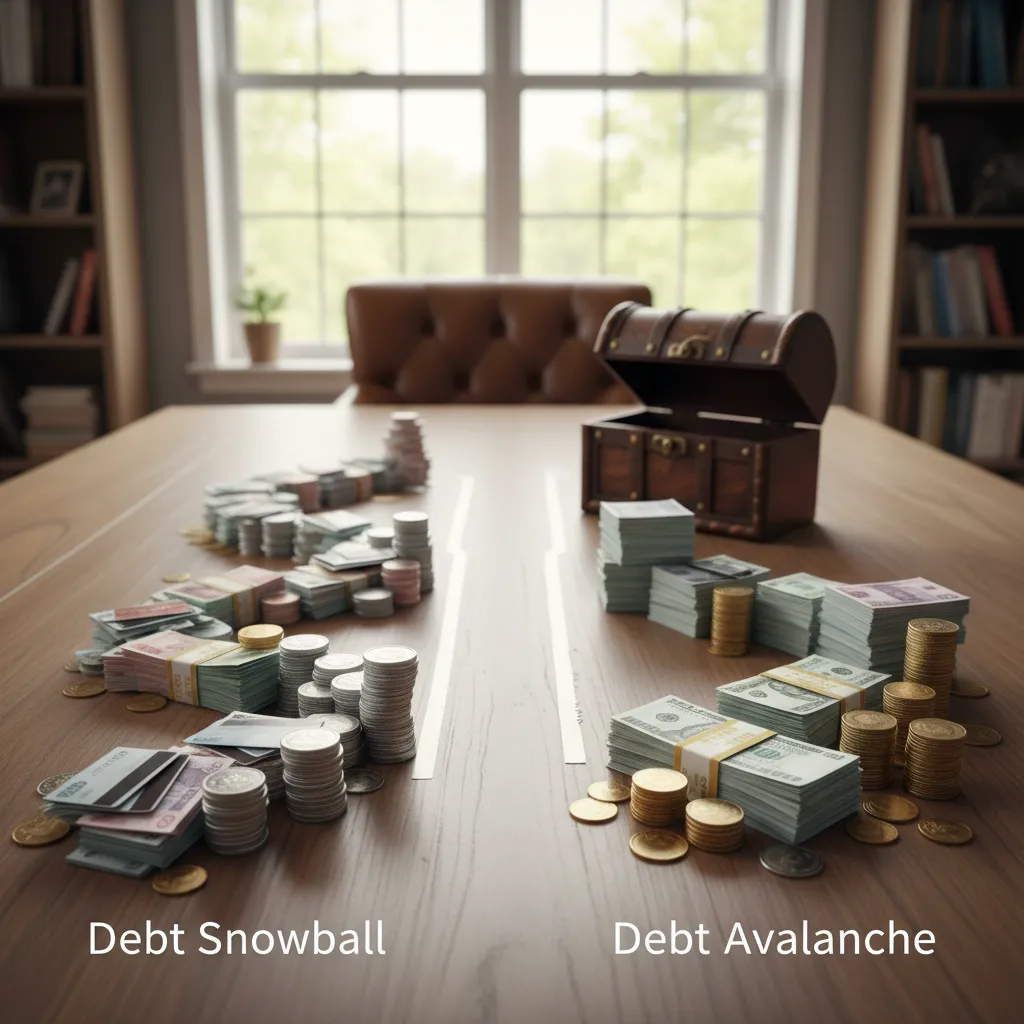
Both methods pay the minimum on everything and put every extra dollar on one target:
- Avalanche: target the highest interest rate first. It always costs the least.
- Snowball: target the smallest balance first. It pays off whole accounts sooner.
An illustration with $900 a month available and three cards:
| Debt | Balance | APR | Minimum |
|---|---|---|---|
| Card A | $1,200 | 19.99% | $40 |
| Card B | $7,500 | 28.99% | $190 |
| Card C | $4,300 | 23.99% | $110 |
| Method | Order paid off | First account gone | Debt-free | Total interest |
|---|---|---|---|---|
| Avalanche | B, C, A | Month 12 | Month 18 | $2,691 |
| Snowball | A, C, B | Month 3 | Month 18 | $3,014 |
The avalanche saves about $320 here. The snowball clears its first account nine months sooner. The gap grows with larger balances and wider rate differences, and it disappears when the smallest balance also has the highest rate.
The research favors focus more than either method. People tend to pay down small balances first even when it costs them, a pattern Amar and colleagues called debt account aversion in 2011. And in a 2016 study using data from a personal finance app plus three experiments, Kettle, Trudel, Blanchard, and Häubl found that concentrating repayments on one account increased people's motivation to get out of debt, most of all when the account was small. Spreading extra payments evenly across every card is the approach to avoid. Pick the avalanche if you will stick with it; pick the snowball if early wins will keep you going.
Lowering the rate
Balance transfer cards
As of September 2026, several cards offer 0% on transferred balances for up to 21 months, most with a 3% to 5% transfer fee (see current offers at sites such as CNBC Select). An illustration with $8,000 at 24%:
| Approach | Monthly payment | Months | Cost |
|---|---|---|---|
| Keep paying at 24% | $400 | 26 | About $2,319 interest |
| Transfer with a 5% fee, 21 months at 0% | $400 | 21 | $400 fee |
| Same transfer, paying $300 | $300 | 21 | $400 fee, then $2,100 left at the card's regular rate |
The rules that decide whether it works: divide the balance plus fee by the number of promotional months and pay at least that much; do not use the new card for purchases, since they may accrue interest at the regular rate; and complete the transfer within the window the offer requires, often 60 to 120 days. Issuers usually will not let you transfer between two of their own cards.
Personal loans
A fixed-rate personal loan turns card debt into a set payment with an end date. The Fed's average for a 24-month bank personal loan was 11.86% in the second quarter of 2026; your rate depends on your credit. At that rate, $8,000 over 24 months costs about $376 a month and $1,026 in interest. Watch for origination fees deducted from the loan amount, and close or stop using the cards you paid off only if you are confident you will not rebuild the balances. Federal credit unions generally cannot charge more than 18%, which makes them worth checking if your credit is fair.
Asking your issuer
Calling to ask for a lower rate costs nothing and sometimes works, especially with a record of on-time payments. If you have lost income, ask about a hardship program, which can temporarily reduce the rate or payment. Get the terms in writing.
Rate caps and other 2026 news
In January 2026 the President called for a one-year 10% cap on credit card rates, and bills in the Senate (S. 381) and House would impose one. As of September 2026 no cap has been enacted, and a binding cap would require legislation. Do not plan around one. The CFPB's $8 late fee rule was vacated by a federal court in April 2025, so late fees remain set by issuers within older limits.
Credit score effects
- Utilization. Amounts owed make up about 30% of a FICO score, and card utilization, your balances divided by your limits, is the main part of that. It updates as balances are reported, so paying down cards often raises scores within a month or two.
- Closing cards. If you owe $10,000 against $20,000 of limits, utilization is 50%. Close a paid-off card with a $5,000 limit and the same $10,000 is 67% of your remaining $15,000. Keep no-fee cards open and put a small charge on them every few months so the issuer does not close them for inactivity.
- New accounts. A balance transfer card or loan adds a hard inquiry and a new account, which usually lowers a score slightly for a while. Lower utilization often more than offsets it.
Our credit score guide covers the rest of the score.

When you cannot keep up
If minimums are more than you can pay:
- Nonprofit credit counseling. Agencies affiliated with the NFCC can set up a debt management plan: you make one payment to the agency, and card issuers typically agree to lower rates and waive some fees. The principal stays the same, the plan usually runs three to five years, and the enrolled cards are usually closed.
- Debt settlement. A settlement company negotiates to pay less than you owe, usually after you stop paying for months, which damages your credit and can lead to lawsuits. Under FTC rules, debt relief companies cannot charge fees until they have settled a debt. Forgiven debt of $600 or more is generally reported on Form 1099-C and taxed as income unless an exception such as insolvency applies (IRS Topic 431).
- Bankruptcy. Chapter 7 or Chapter 13 can discharge or restructure card debt. It stays on credit reports for years, and a consultation with a bankruptcy attorney is the way to see whether it fits.
Avoid paying cards with a 401(k) loan or withdrawal unless there is no other option; withdrawals before 59½ generally add a 10% penalty on top of income tax, and a loan becomes due quickly if you leave your job.
A payoff plan
- List every debt with balance, rate, and minimum, and automate the minimums.
- Keep a small cash buffer and capture any employer match.
- Pick avalanche or snowball and put every extra dollar on the one target.
- Check whether a 0% transfer or a personal loan lowers your rate, and do the math with the fee included.
- Call your issuers to ask for a lower rate or a hardship program.
- When a debt is paid off, add its minimum to the next target.
- Keep paid-off no-fee cards open, and stop using any card you keep running back up.
This guide is for informational purposes only and does not constitute financial, tax, or legal advice. Rates and card offers are as of September 2026 and change often; the worked examples are illustrations. Consider speaking with a nonprofit credit counselor or a fiduciary financial adviser about your situation.
Frequently Asked Questions
Share this article
Related Articles

Debt Consolidation Options Compared: Personal Loans, HELOCs, 401(k) Loans, Payment Plans, and Settlement
What each way of consolidating debt really costs: lender fees and APRs, home equity risk, 401(k) loan rules, NFCC plans, and settlement, with checked totals.

FIRE in 2026: Savings Rate Math, Safe Withdrawal Rates, Health Insurance, and Early Access to Retirement Money
FIRE math for 2026: savings rate vs. years to FI, withdrawal rate research, sequence risk, the ACA subsidy cliff, and penalty-free access before 59½.

Wealth Management Fees: AUM Schedules, Flat Fees, Fund Costs, and What the Fee Buys
Real advisor fee schedules and Kitces survey data, plus a 30-year cost table for 1% AUM, tiered, robo, and flat fees, and what Vanguard says advice adds.

How Much Should Your Business Borrow? Debt Capacity, Fixed vs Floating Rates, and Covenant Headroom
Size business debt with DSCR and leverage multiples, choose fixed or floating with SOFR near 3.9%, keep covenant headroom, and run a rate-shock test.